A university teaches the discipline where it is practised
Brock University's Cool Climate Oenology and Viticulture Institute doesn't study cold-climate viticulture from a distance — it works inside the region whose problems it is trying to solve.

Bench glassware at the institute that sits inside the region it studies.
The institution and its address
There is a logic to where research gets done. Wine science has prestigious centres in Bordeaux, in Davis, in Geisenheim — and what they know about their regions they know because they are embedded in them, reading soils and seasons across many years from the same piece of ground. Brock University, a mid-sized comprehensive university in St. Catharines on the Niagara Peninsula, understood that logic early. When it established the Cool Climate Oenology and Viticulture Institute ↗, known universally in the industry as CCOVI, it placed the institution not adjacent to the wine region but inside it, on the escarpment's northern edge, within reach of every sub-appellation the peninsula defines.
St. Catharines sits at the foot of the Niagara Escarpment, the great limestone-and-dolostone ridge that runs across the peninsula and separates the warmer benchland soils from the cooler plain below. That geography is not incidental to what CCOVI researches. The escarpment creates the slope drainage, the cold-air displacement and the moderating relationship with Lake Ontario that make viticulture possible this far north. Understanding how it functions — how the lake effect buffers killing frosts, how the benches trap and radiate heat differently from the flatlands — is primary research, and the institute's physical location puts its researchers within driving distance of every vineyard block they study.
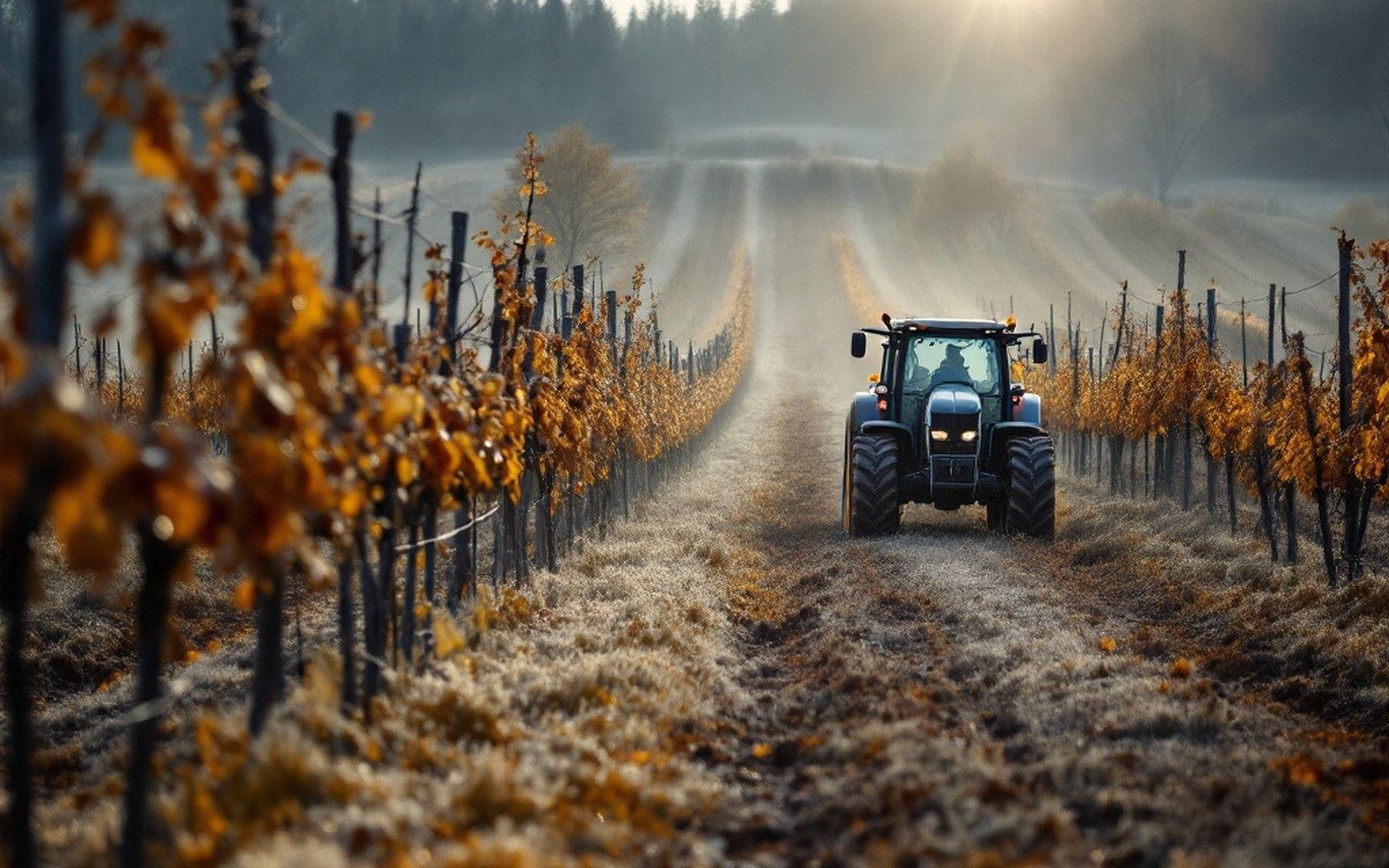
A tractor at the end of the row: the growing half of a relationship that is still negotiated.
CCOVI was formally established in 1996, built on earlier wine-science work at Brock, and grew as the provincial industry grew. By the mid-1990s, VQA — the Vintners Quality Alliance appellation system codified in provincial legislation in 1999 — was beginning to demonstrate that serious Niagara wine was not an accident, and the region needed a research base equal to that ambition. A university already present in the region was the natural host.
What the institute actually does
CCOVI runs across three registers simultaneously: it trains, it researches, and it advises. The training is undergraduate and graduate, with degree programmes in oenology and viticulture that move students through laboratory chemistry, sensory science and vineyard management in a region that provides the full range of cool-climate problems — winter injury, compressed harvest windows, late-season rot pressure, the varietal question of which grapes the climate actually suits. Graduates enter an industry that already speaks their language, because the institute was built to speak the industry's.
The research programme is where CCOVI earns its wider reputation. Viticulture work covers vine physiology under cold stress, frost risk modelling, soil-vine interaction on the escarpment benchlands, and the mechanics of winter protection — including the hilling-up practice by which growers bury the graft union each autumn to shield it from the temperatures that kill vinifera rootstocks outright. Winter kill is not an academic abstraction here; it is a recurring production risk, and research that improves a grower's ability to assess site exposure or predict injury thresholds has direct economic consequence.
The oenology side tracks what happens after harvest: fermentation chemistry for cool-climate aromatic whites, the particular demands of icewine production — picking and pressing at or below −8°C, as VQA rules require, which creates handling problems unique to frozen fruit — and the relatively newer local interest in appassimento, the technique of drying harvested grapes before pressing to concentrate sugars and flavours in a short growing season. When growers or winemakers encounter a technical problem that has no answer in the California or Australian literature, CCOVI is the first call, because the problem exists in the same climate the institute works in.
CCOVI was formally established in 1996, built on earlier wine-science work at Brock, and grew as the provincial industry grew.
The advisory function is less formal but no less real. CCOVI researchers appear at industry days, publish findings in formats growers can use, and maintain working relationships with the Ontario Grape Growers — the association that represents the growing side of the industry and that predates the appellation system by decades. The relationship between the research institution and the producers' body matters because in a small industry with a defined geography, the gap between knowledge and practice closes faster when the people doing both know each other and share a regional interest.
Growing degree days and the limits of the climate
One of the most concrete contributions CCOVI makes to regional understanding is the ongoing measurement and modelling of thermal accumulation — growing degree days, the unit by which viticulturists measure how much heat a season actually delivers to ripening fruit. The Niagara Peninsula accumulates enough degree days to ripen a defined range of varieties: Riesling, Chardonnay, Pinot Noir, Cabernet Franc, and the thick-skinned hybrids like Vidal that were selected precisely for their cold tolerance. Understanding where within the region degree-day accumulation is highest, how that varies between a bench site and a floor site and a lake-front site, and how the numbers shift year to year gives growers a tool for varietal selection and harvest timing that goes well beyond intuition.

Terraced slopes in a cool river valley — the kind of place Ontario is usefully measured against.
The lake effect on that thermal budget is substantial and nuanced: Lake Ontario's mass delays both spring warming and autumn cooling, extending the frost-free window and allowing late-ripening varieties more time than the latitude alone would suggest. But the lake does not distribute its influence evenly. CCOVI's climate research, in partnership with the university's geography department and with external partners including Environment and Climate Change Canada ↗, attempts to resolve that variability at the sub-appellation scale — the difference between Four Mile Creek, sheltered and frost-prone in its low ground, and Beamsville Bench, elevated and better-drained, matters to a grower choosing what to plant and matters to the appellation system deciding where those distinctions deserve their own names.
The institution in the regional system
Brock and CCOVI are not official bodies within the VQA regulatory structure, but they are woven into the institutional fabric that makes that structure credible. The appellation system certifies origin and compliance; it does not itself generate the agronomic knowledge that tells producers how to succeed within the rules. That knowledge comes from research, and in the Niagara Peninsula, the research address is CCOVI.
This is what it means for a university to teach the discipline where it is practised. The curriculum includes the escarpment as a physical object, the lake as a climate mechanism, winter as an annual adversary, and the compressed harvest as a logistical reality. Students in viticulture at Brock are not reading about a generic cool climate; they are walking the benchlands in October, measuring brix in blocks that their instructors have been monitoring for years. The growers who employ those graduates, or who call the institute when a season turns difficult, are working in the same landscape. The knowledge does not have to travel far to be useful. In a region where the margin between a vineyard's success and its failure can be a single site decision made decades before the fruit is picked, keeping the research close is not a courtesy — it is the point.