Burying the graft union is routine labour here
Every autumn, Niagara growers bury the base of each vine. Every spring, they dig it out again. No other single task takes more hours.
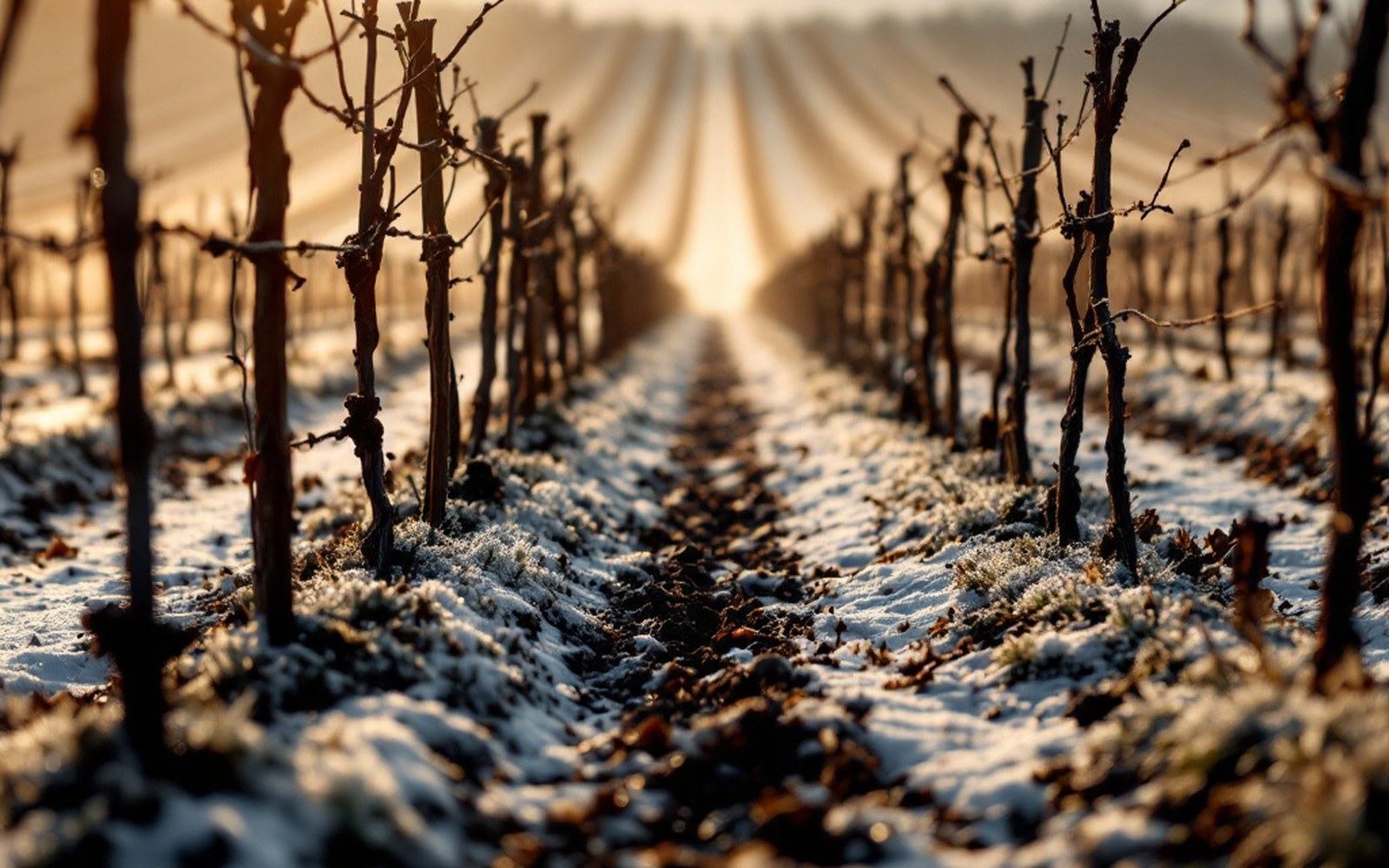
The ridge of soil covering the graft union. It goes on in November and comes off in April.
What hilling up actually protects
A grafted vinifera vine has a seam. Below it is the rootstock — selected for vigour, for phylloxera resistance, for compatibility with the site — and above it is the scion, the variety that will eventually produce Riesling or Cabernet Franc or Chardonnay. That seam is the graft union, and it is the vine's most vulnerable point in winter. The rootstock, often derived from hardy native American species, may tolerate temperatures that would badly damage the scion; the scion, being Vitis vinifera, may survive down to around −15°C to −18°C under the right conditions. But the graft union itself is more susceptible than either, and Ontario's winters regularly deliver the temperatures needed to kill it outright.
The response is ancient and entirely practical: bury it. Growers run a disc or a plough along each row in late autumn, drawing soil from between the vines up and over the base of each plant until the graft union sits beneath ten to thirty centimetres of earth. The soil acts as insulation. Ground temperature at that depth is far more stable than air temperature — the violent swings of a Niagara January, from thaw to hard freeze and back, are damped to something a root system can survive. The practice is called hilling up, and in the Niagara Peninsula it is not precautionary in the way one might winterise a garden tap: it is the difference between a vineyard that comes back in spring and one that does not.
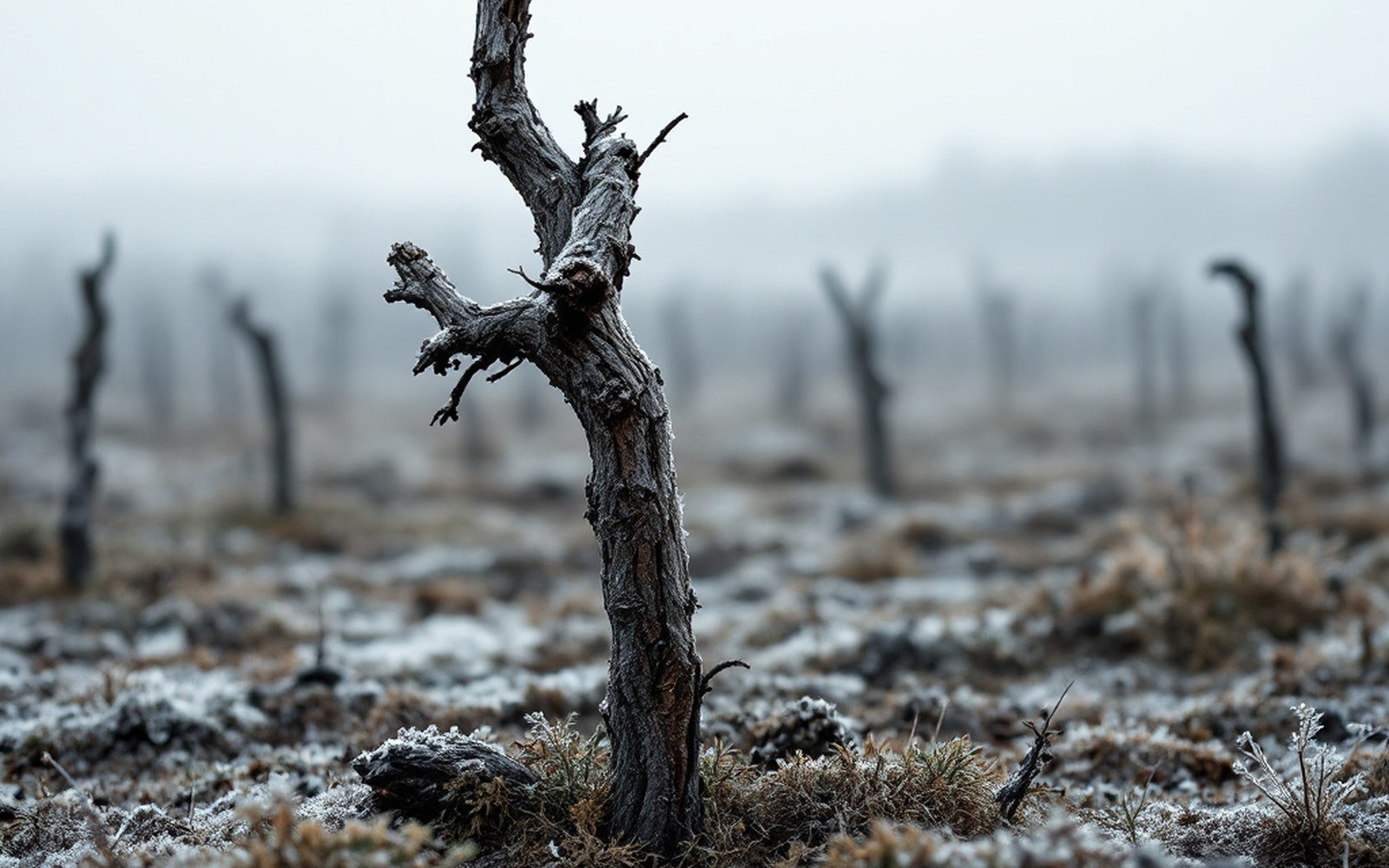
Split bark on a dead trunk. One night decided this, and the block around it lost years of wood.
Why this particular region demands it
The lake effect buys Niagara growers a longer growing season than the latitude alone would suggest, and the Niagara Escarpment keeps cold air draining off the bench sites through winter. But neither mechanism is a guarantee. Cold air masses arriving from the northwest can push temperatures well below −20°C, and the graft union, sitting a few centimetres above soil level on a dormant, leafless vine, has nothing else protecting it. Sites on the Beamsville Bench or Twenty Mile Bench are better drained and marginally warmer than the flat below, which is part of why they were planted, but even they are not exempt.
Winter kill is not a theoretical hazard. Niagara has lost significant vine populations in severe winters, and the losses are not uniform: a slightly low-lying block, a variety with lower cold hardiness, a vine whose soil was hilled too thin or too late — each raises the risk. The graft union is consistently the first point of failure when temperatures drop far enough. Replacing a dead vine means replanting, waiting several unproductive years for the replacement to bear, and accepting a gap in uniformity. Hilling up is the calculation that those costs are worse than the labour of doing it annually.
The scale of the task
Scale is what makes hilling up the dominant labour item in a Niagara winter operation. A modest vineyard of ten hectares contains tens of thousands of individual vines. The mechanical pass with a disc or specialised hilling plough moves quickly enough along each row, but the machine cannot complete the job: around each trunk, where the equipment cannot reach without damaging the vine, the soil must be pulled in by hand or with a smaller tool. A crew works its way down every row in a narrow window between leaf fall and the arrival of ground frost that makes the soil unworkable. Then, come April, when the risk of severe frost has passed but before the new season's growth begins, the entire operation runs in reverse — the soil is pulled back, the graft union is uncovered and inspected, and the vine is assessed. Damaged unions are noted. Replanting decisions are made.
The Cool Climate Oenology and Viticulture Institute at Brock University has studied cold hardiness in Niagara vines, and the Ontario Grape Growers ↗ association provides growers with guidance on timing and technique — both reflecting the same underlying reality that vinifera ↗ cultivation at this latitude is a managed negotiation with winter, not an escape from it. Hilling up is how that negotiation is conducted, vine by vine, row by row, twice a year without fail.
The graft union is consistently the first point of failure when temperatures drop far enough.