Harvested frozen, by rule, at minus eight
The temperature is a legal definition before it is a logistical one, and both problems belong to the same night.
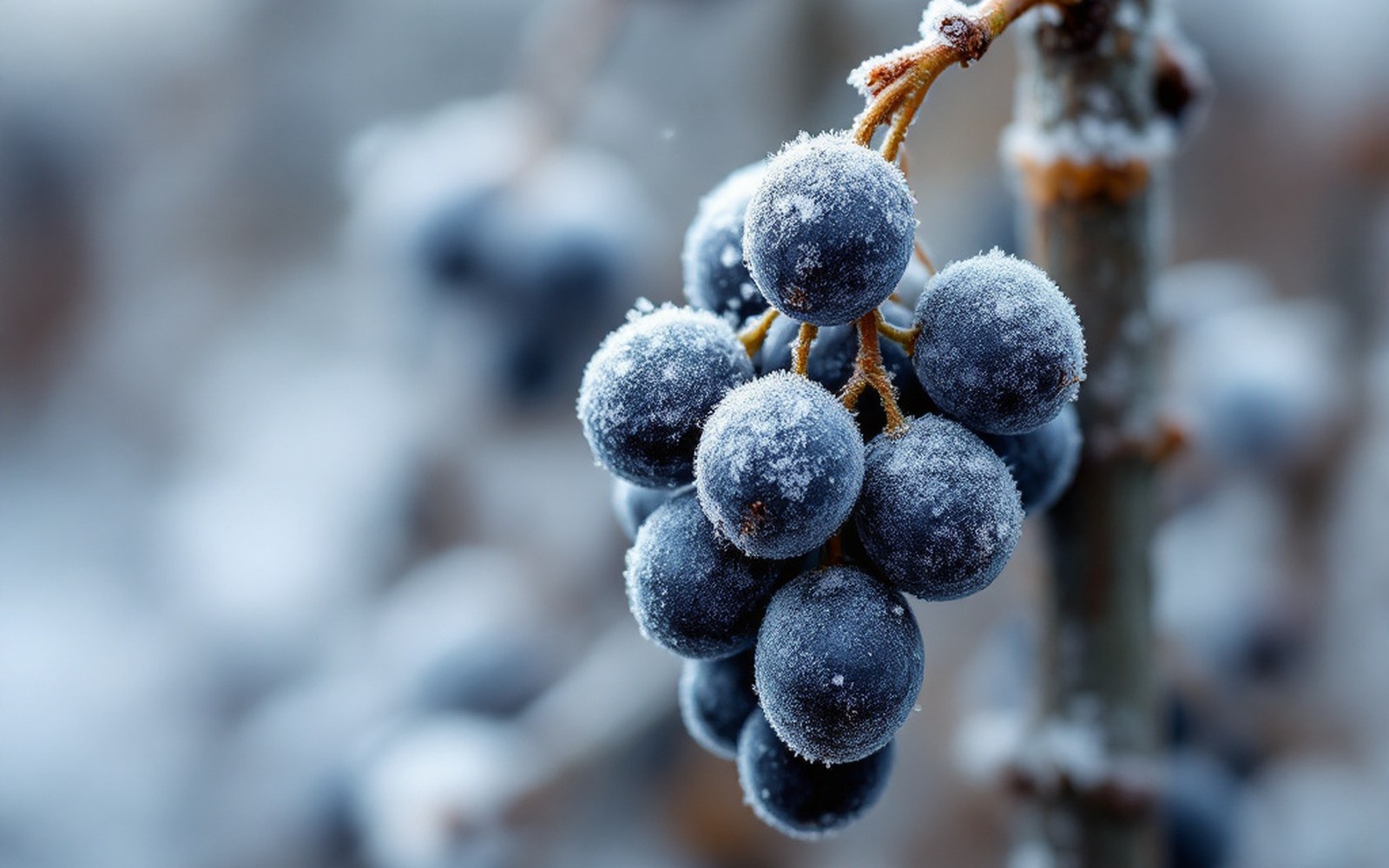
Naturally frozen fruit on the cane. The rule that governs this picture is a temperature, not a date.
The rule itself
Icewine occupies a precise regulatory position in Ontario wine. To carry the name on a VQA label, the fruit must be harvested and pressed while naturally frozen, at a temperature of −8°C or colder. That is not a guideline or a target — it is the floor, and the monitoring of it is documented at the point of harvest. The freeze must be natural, which rules out mechanical freezing entirely: a warehouse and a compressor cannot produce icewine. The water in the berry must freeze on the vine, in the field, by winter, concentrating sugars and acids into a fraction of the berry's normal juice volume.
VQA Ontario's production standards define the requirement in language that leaves no room for interpretation. The sugar levels that result — Brix readings that would be startling in any other wine — are themselves regulated, and the grapes permitted are a defined list. Riesling and Vidal are the workhorses. Vidal, a hybrid with thick skins developed partly for cold-climate endurance, hangs reliably through freeze after freeze without splitting; it is the grape the category was practically built around, even if Riesling produces the icewines most likely to age. Cabernet Franc appears in small volumes of red icewine, its colour deepened by the concentration.
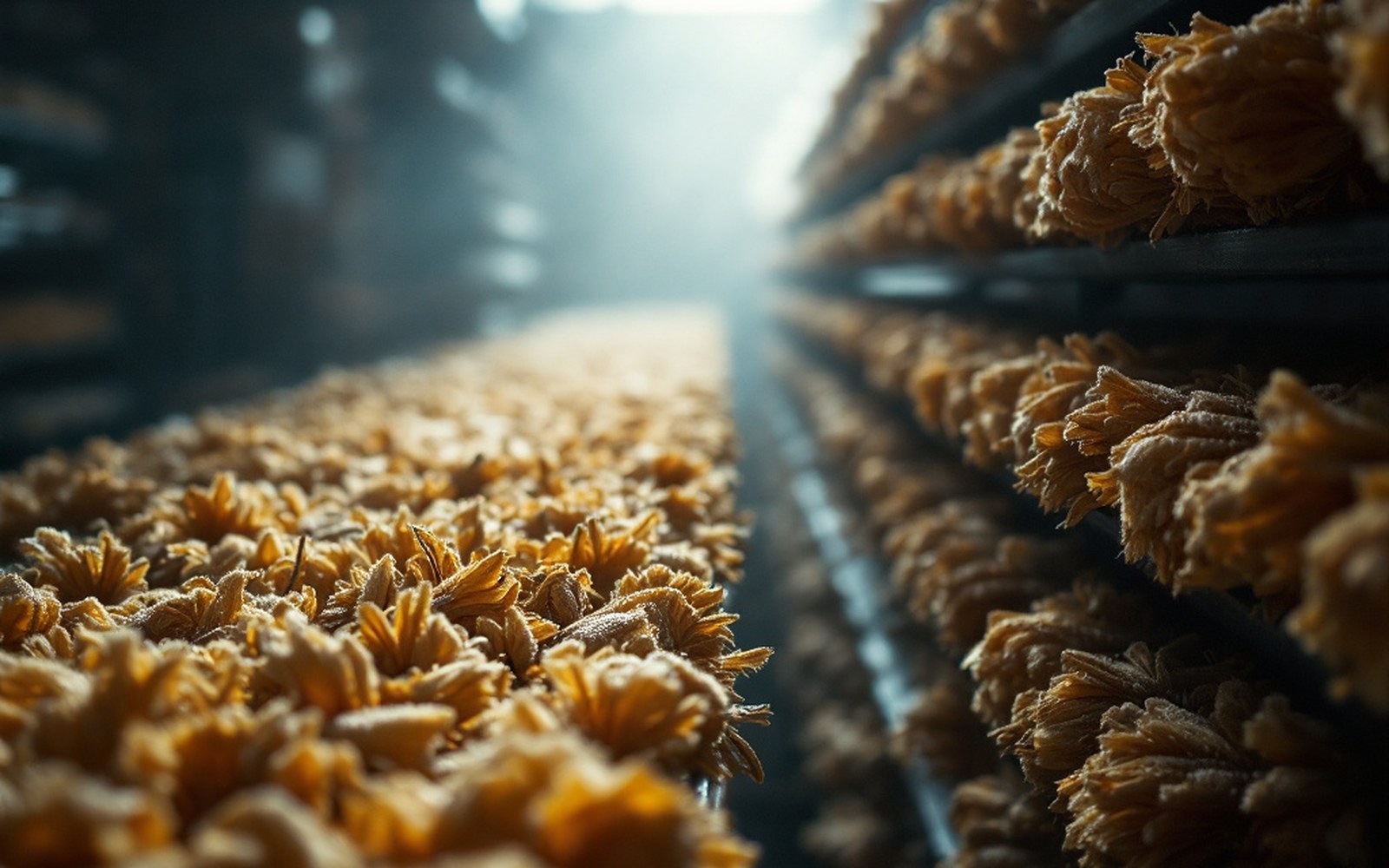
Bunches drying on racks. Water leaves, sugar concentrates, and a short season is made up indoors.
The logic of the rule is straightforward: below −8°C, water in the berry has frozen solid while the dissolved sugars, acids and flavour compounds remain liquid. When frozen berries are pressed, that liquid fraction — the must — flows out under pressure while the ice stays behind. The result is a must so rich in dissolved solids that fermentation is slow, difficult and terminates with significant residual sugar. The wine that follows is sweet by definition, not by addition.
The night this actually demands
Knowing the rule is one thing. Living the harvest is another. Ontario's winters arrive unevenly, and the Niagara Peninsula — insulated by Lake Ontario's thermal mass — sometimes reaches December or January before temperatures drop reliably to −8°C and hold there. Growers who have committed fruit to icewine production must leave those clusters on the vine through autumn, through rain, through the first mild freezes that do not qualify, through the rot pressure that any extended hang time invites. Botrytis is an enemy here: damaged skins lose moisture unpredictably and the berry shrivels rather than freezing clean.
The harvest itself happens in darkness, almost always between midnight and dawn, because temperatures tend to fall furthest in the pre-dawn hours and the window at or below −8°C can be narrow. Pickers work by lamp and by hand; mechanical harvesting is not feasible at these temperatures and with clusters that are essentially frozen solid on the cane. The cold is not incidental — it is the point — but it means the work is brutal. Gloves impede grip. Equipment oils thicken. Picking bins must be kept cold enough that the fruit does not warm between vine and press.
The press itself must operate fast. A cluster of frozen Vidal or Riesling warms the moment it leaves the vineyard air, and a few degrees of warming can be enough to allow the ice to begin releasing diluting water into the must. Pressing is therefore done outside, or in unheated facilities, with the thermometer still monitored. Yields at this point are radically small — a vine that would produce several litres of regular must might yield a fraction of that as icewine must. The economics follow from that number directly, though the rule, not the economics, is what defines the category.
VQA Ontario's production standards define the requirement in language that leaves no room for interpretation.
What the appellation protects and why it matters
Ontario was not the first place to make icewine, but it became, over the decades following the founding of VQA in 1988, the most consistent producer of it in the world by volume. Germany's Eiswein — the original — depends on an event that some vintages never deliver. Ontario's winters are cold enough, and reliably enough, that producers can commit to icewine production as a product line rather than a rare accident. The Niagara Peninsula, the Niagara Escarpment's sub-appellations and, on colder years, Prince Edward County all sit in a climate zone where −8°C is a question of when rather than whether.
That consistency was precisely what made regulation urgent. If Ontario icewine was going to reach markets around the world — and it does, the category is a significant export — buyers needed to know what the name guaranteed. The VQA standard functions here as it does across the appellation system generally: it certifies origin and method, not quality in any subjective sense, but the method in this case is so specific that certifying it is tantamount to guaranteeing a minimum character. A wine that meets the harvest temperature requirement, the approved grape list and the minimum Brix at pressing will be, structurally, an icewine — intensely sweet, high in acid, low in alcohol, the product of a particular kind of cold.
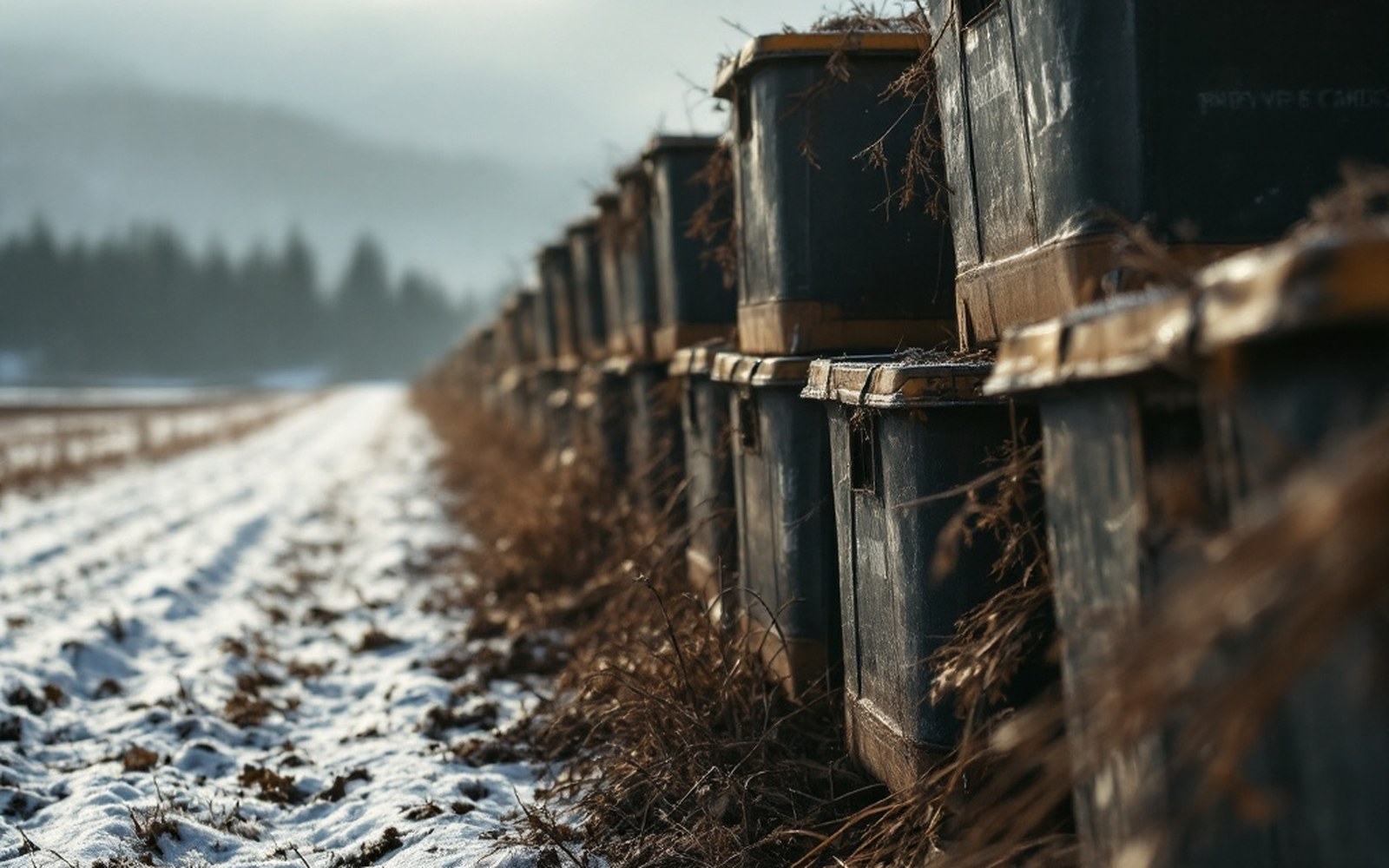
Empty bins at the end of a row. The limit on how much gets made is usually the crew, not the fruit.
The word "natural" in the rule carries real weight internationally. Canadian law governing icewine ↗ under the Food and Drugs Act framework requires that the freeze be achieved without artificial intervention, and this distinction separates Canadian icewine from some products sold under similar names in other markets where mechanical cryo-extraction is permitted. That is not a trivial difference in process — it is the whole point of leaving fruit on the vine until January.
What can go wrong and what it costs the grower
The risks compound over a long hang. A warm spell in December can cause shrivelling or secondary fermentation inside damaged berries. A freeze too hard and too sudden — temperatures well below −12°C or −15°C — can damage the berry structure so completely that pressing yields almost nothing. The window that actually works is narrow: cold enough to freeze the water, not so cold that the berry becomes unworkable material.
Disease pressure across the hang is continuous. Growers managing icewine blocks must decide, each autumn, how much of their crop to commit and watch the weather with a particular kind of attention. They may have nets over the vines to deter birds, who are interested in the concentrated, sweetening fruit long before any harvest. The nets add cost; removing them adds labour on a night when labour is already stretched. A block held for icewine that does not yield a qualifying harvest — because the temperature never drops far enough, or because disease pressure overwhelms it — is not a block that produces anything else. The fruit is gone.
Brock University's Cool Climate Oenology and Viticulture Institute ↗ has documented cold-hardiness and freeze-damage thresholds for the cultivars grown in Niagara, and that research informs how growers now think about variety selection and site placement for icewine production. Not every block is suitable; a low-lying site prone to air drainage and early hard frost behaves differently than one on the mid-slope of the Beamsville Bench. Site matters before variety, and variety matters before anything in the winery.
The rule, finally, is both constraint and guarantee. Minus eight is the temperature at which a Canadian icewine begins to be itself — not at bottling, not at pressing, but on the vine, in the dark, in January, when the thermometer drops and holds and the crew arrives.