Mosel, Kamptal, the Finger Lakes
Where the discipline is the same and the details are not

Terraced slopes in a cool river valley — the kind of place Ontario is usefully measured against.
What the comparisons teach
Ontario's wine identity is built on constraint, and constraint creates kinship. The Niagara Peninsula earns its place in a short list of cool-climate wine regions not by chasing a warm-region style but by accepting the same pressures those regions accept — marginal heat, real winters, late ripening, the constant arithmetic of degree days. The useful comparison is not Napa or the Rhône but the Mosel, the Kamptal, the Finger Lakes: places where Riesling is the answer because the question is always how do you ripen anything here?
The Mosel ↗ presses its vines against near-vertical slate slopes above the river, squeezing every degree of reflected warmth from the stone. Yields are low, acids are high, and the wines are unmistakably themselves — not despite the difficulty but because of it. The Kamptal, in Austria's Danube basin, works with a similar logic on loess and crystalline rock, where cold continental nights preserve the aromatic precision that Riesling and Grüner Veltliner need. Both regions have been at this for centuries. Ontario has been at it seriously for roughly four decades. That gap in institutional age is real, but the underlying physics is the same: accumulated warmth measured against the vine's minimum requirements, harvest compressed by a shortening autumn, and winter always waiting at the edge of the map.
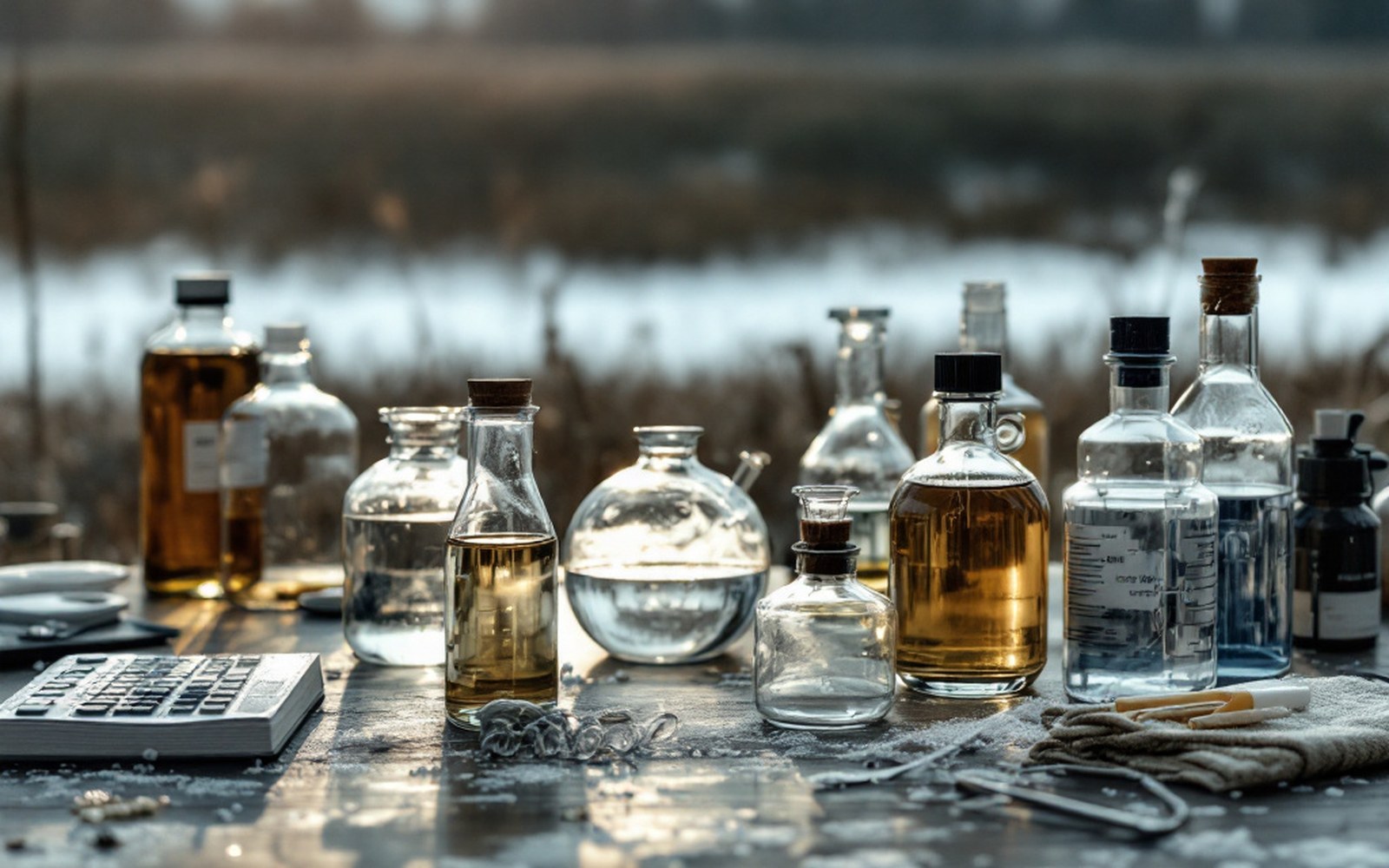
Bench glassware at the institute that sits inside the region it studies.
The Finger Lakes parallel
No comparison is closer — geographically, climatically, or institutionally — than the Finger Lakes of upstate New York, directly across Lake Ontario. The two regions share a continental climate moderated by deep glacial lakes, a dependence on that moderation to push through a marginal growing season, and a short list of varieties that actually ripen reliably. Both arrived at Riesling as their most convincing argument. Both deal with the same threat of winter kill to vinifera — the European Vitis vinifera varieties that are most susceptible to the cold — and both regions have growers who have made the same bet on site selection that a single bad winter can erase.
The differences are instructive too. The Finger Lakes carry more of their viticultural weight on hybrid varieties: Cayuga White, Traminette, the ubiquitous Catawba and Concord of the region's older commercial tradition. Niagara has hybrids as well — Vidal dominates the icewine category, and Baco Noir and Maréchal Foch have real commercial presence — but the emphasis shifted more decisively toward vinifera during the 1980s and 1990s, driven in part by the voluntary standards that became the Vintners Quality Alliance appellation system in 1988. The VQA's Ontario appellation rules require that certified wines be made entirely from Ontario-grown grapes, and sub-appellations like the Beamsville Bench and Twenty Mile Bench impose further specificity on origin. The Finger Lakes have their own American Viticultural Area designations, but the institutional architecture is different, and the market relationship with a single dominant retailer — in Ontario's case, the LCBO — shapes what gets made and in what volumes in ways that have no direct Finger Lakes equivalent.
What the comparisons do and do not prove
Cool-climate solidarity is real but can be overstated. The Mosel's slate slopes and the Beamsville Bench's clay-heavy glacial till are not the same growing medium. Kamptal Grüner Veltliner has no meaningful Niagara analogue. Comparing yield-per-hectare figures across regions whose regulations, classifications and measurement conventions differ is an exercise in false precision. What the comparisons genuinely establish is a frame: these are regions where viticulture is hard, where the margin between a successful vintage and a failed one is narrow, and where the wines carry that difficulty in their structure. High natural acidity, moderate alcohol, a precision of flavour that hot-climate viticulture cannot replicate — these are not compensations for the climate but its direct products.
Brock University's Cool Climate Oenology and Viticulture Institute ↗ engages with exactly this international network, sharing research on cold-hardiness, canopy management and harvest timing with counterparts in New York state and central Europe. The knowledge moves across the borders even when the wine cannot. That exchange is what makes comparison useful: not as flattery, but as a discipline.
The Mosel presses its vines against near-vertical slate slopes above the river, squeezing every degree of reflected warmth from the stone.