A cold night can end a vineyard's decade
Site selection on the Niagara Peninsula is not a bet about average winters — it is a bet about the worst one in a decade.
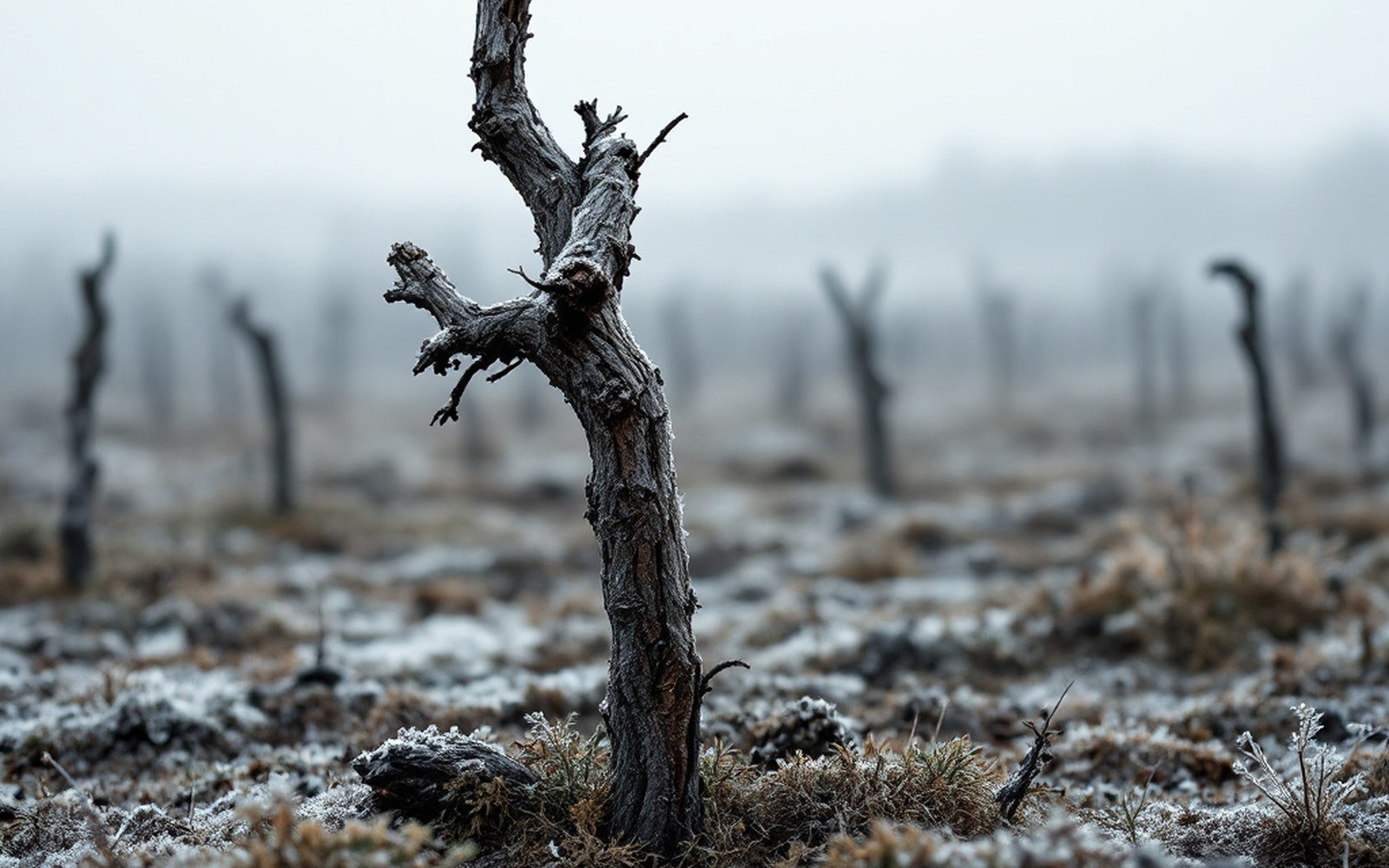
Split bark on a dead trunk. One night decided this, and the block around it lost years of wood.
The number that matters is not the mean
A grower choosing a vineyard site in the Niagara Peninsula will look at the averages: accumulated heat over the growing season, first and last frost dates, typical January lows. Those numbers tell a useful story about whether a given variety can ripen. They tell almost nothing about the risk that actually keeps viticulturalists awake, which is the extreme minimum — the coldest temperature recorded in the coldest year in recent memory, and whether the vine wood survives it.
Vitis vinifera, the European grape species behind every variety from Riesling to Cabernet Franc, begins to suffer primary bud damage at roughly −15°C and sees wholesale cane death approaching −20°C. Older wood can split or die at temperatures that reach into the −25°C range, which Ontario has recorded in parts of the Niagara Peninsula during severe cold outbreaks. The graft union — the junction between the cultivated vinifera top and the rootstock below — is the single most vulnerable point on the plant and can be killed if it is not protected. When it goes, the vine does not regrow as the intended variety: the rootstock shoots up from the ground instead, producing something that bears no useful fruit. The planting is lost.
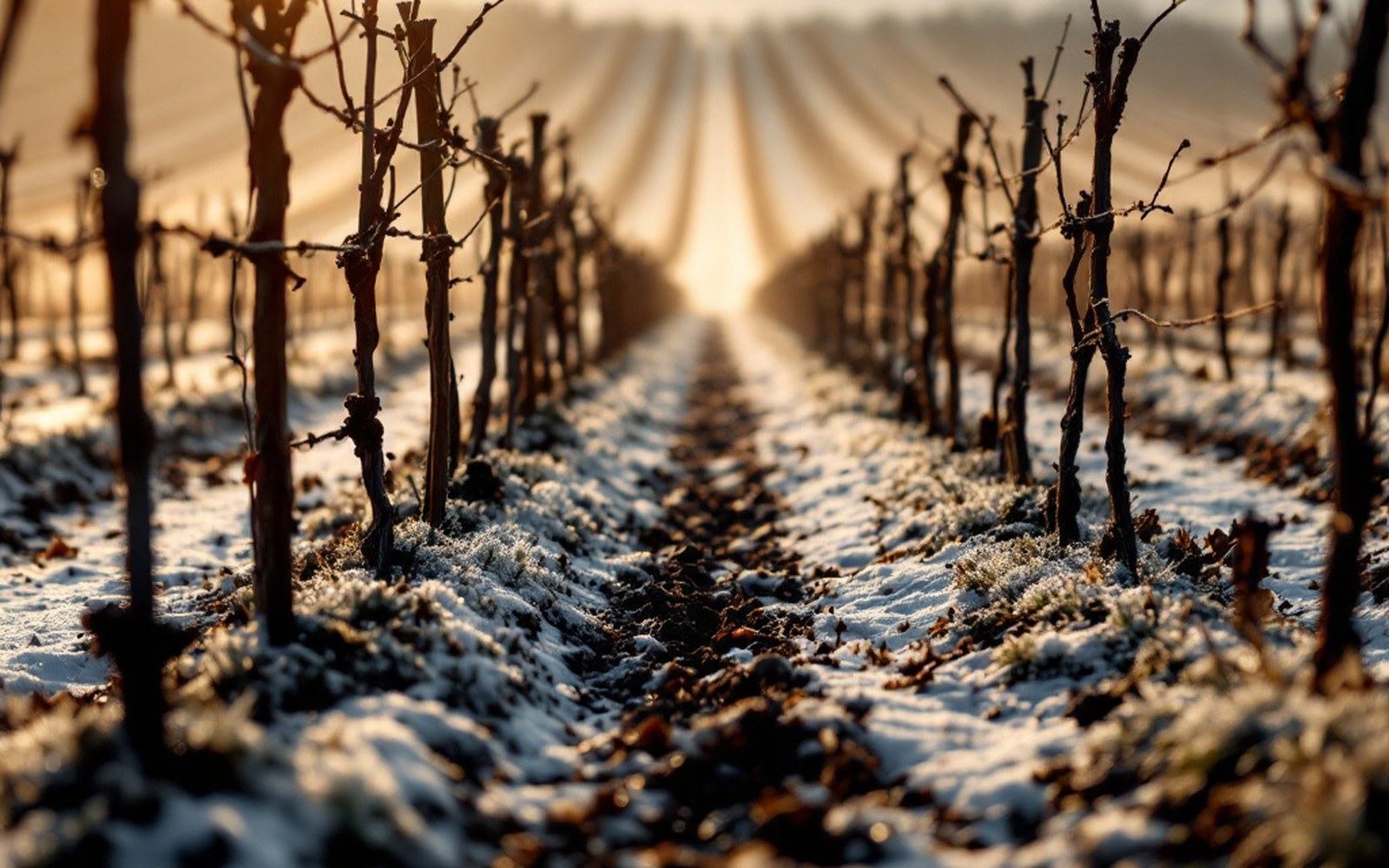
The ridge of soil covering the graft union. It goes on in November and comes off in April.
This is not a theoretical risk. The winters of 1993–94 and 2003–04 caused widespread damage across Niagara, and growers who planted on marginal sites — lower-lying ground, north-facing slopes, parcels without adequate cold-air drainage — suffered losses that took years to recover from. A single catastrophic night can set a vineyard back the better part of a decade when replanting, re-establishment and the lag before full production are counted together.
The physics of a cold site and what the escarpment does
Cold air is dense and flows downhill. On flat or enclosed ground it pools, dropping temperatures several degrees below what surrounding sites experience during a radiation frost ↗ event — the clear, calm, windless nights when the ground radiates its stored heat back into a cloudless sky and the air above drops fastest. This is why the topography of the Niagara Peninsula is not incidental to viticulture; it is viticulture's precondition.
The Niagara Escarpment ↗ runs along the southern edge of Lake Ontario like a berm, and its face catches the moderating effect of the lake while also creating the drainage gradient that saves sites on its slopes. Cold air that would otherwise pool in low-lying areas drains down and away, and the lake's thermal mass — still releasing stored summer warmth well into autumn and mitigating the sharpest drops of early winter — keeps temperatures on the bench and lower slope sites measurably warmer than inland locations. The named benches on the escarpment face — Beamsville Bench and Twenty Mile Bench among them — owe part of their reputation precisely to this: they are terraces where both air drainage and lake influence converge.
None of this is armour against every winter. It is a statistical advantage, improving the odds that the vineyard survives the worst years without crossing the thresholds that kill vinifera wood. A grower selecting a site is essentially pricing risk: a slope with excellent cold-air drainage and a clear sightline to Lake Ontario is a lower-variance bet than a frost pocket two kilometres inland, even if the frost pocket grows perfectly good fruit in the nine years out of ten that the coldest night stays manageable.
When it goes, the vine does not regrow as the intended variety: the rootstock shoots up from the ground instead, producing something that bears no useful fruit.
What growers do when the physics aren't enough
Because site selection cannot fully insulate a vineyard, a set of cultural practices has developed around managing the winter that arrives anyway. Hilling up — drawing soil up over the base of each vine in autumn to bury the graft union before the hardest frosts — is standard practice across much of the Peninsula for sensitive varieties. The soil acts as insulation, holding enough warmth to keep the graft union viable through temperatures that would kill it if left exposed. In spring, the same soil must be drawn back to prevent the vine from rooting above the graft and gradually losing the rootstock's benefits.
Wind machines — tall propeller towers visible across Niagara — address a different problem: the inversion layer that forms on radiation-frost nights, where air just above the fruit zone is actually warmer than the air sitting directly on the vines. The machines mix that warmer air down onto the canopy, raising temperatures in the critical zone by enough to prevent damage. They are effective against the short, sharp cold events that follow clear spring nights, less so against the sustained deep cold of a polar-air outbreak that blankets the region for days.
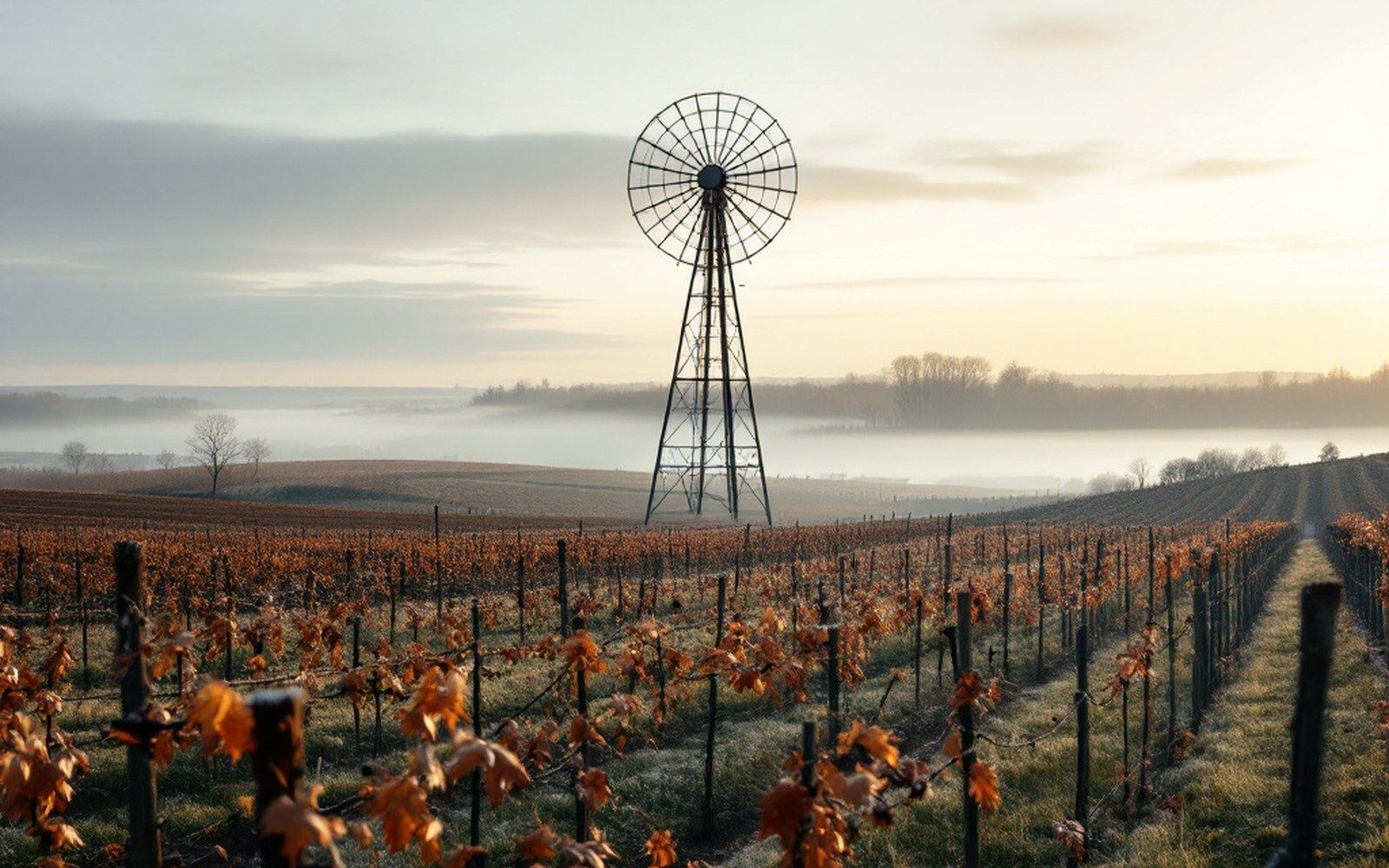
A fan tower over the fruit zone — bought once, for the nights that arrive every few winters.
Variety selection is the third lever. Hybrids — crosses between vinifera and cold-hardy North American Vitis species — survive temperatures that would kill their vinifera parents outright. Vidal, the workhorse of Ontario icewine production, is a hybrid, and its thick skins and cold tolerance are part of why it became the dominant variety for a style that requires the grapes to hang on the vine through natural freezing. Baco Noir and Maréchal Foch, planted decades before the vinifera expansion of the 1980s and 1990s, survive Niagara winters with essentially no winter-kill concern. The tradeoff is in the wine styles and market positioning that each variety makes possible; the cold-hardiness of hybrids comes bundled with flavour profiles and quality ceilings that are genuinely different from those of vinifera.
The decade-bet framing
All of this frames how a grower should think about site selection. The question is not whether a site can produce Cabernet Franc in a warm year — the answer, across most of the Peninsula, is yes. The question is whether the site can hold a viable Cabernet Franc planting through the one winter in ten that delivers −22°C for three consecutive nights. A vine that dies in that event and must be replanted loses not only the year of death but the replanting cost, the years before the young vine reaches productive maturity, and the capital tied up in a block that is not generating returns. Over a generation of viticulture, the growers who chose sites with genuine cold tolerance — elevation, drainage, lake exposure — and paired them with varieties whose threshold for death sits below Ontario's realistic worst-case minimums have compounded their advantages in a way that does not show up in any single vintage's weather data.
Brock University's Cool Climate Oenology and Viticulture Institute ↗ has contributed long-running research on winter hardiness and cold-climate site assessment, feeding technical knowledge back into the industry precisely because the discipline of understanding the cold is not separable from the discipline of growing here at all. The appellation system built under the Vintners Quality Alliance formalised the geography — designating the sub-appellations, requiring that grapes used in labelled wines actually come from the stated area — but the geography itself was the precondition, and its logic is the logic of surviving the worst night, not the average one.
The vine that comes through February intact is the vine that makes the September wine. Everything else is commentary.