Towers that mix the air on the coldest nights
When the sky is clear and the wind drops, cold air pools in the vine rows. A machine on a tall mast can unmake that pooling.
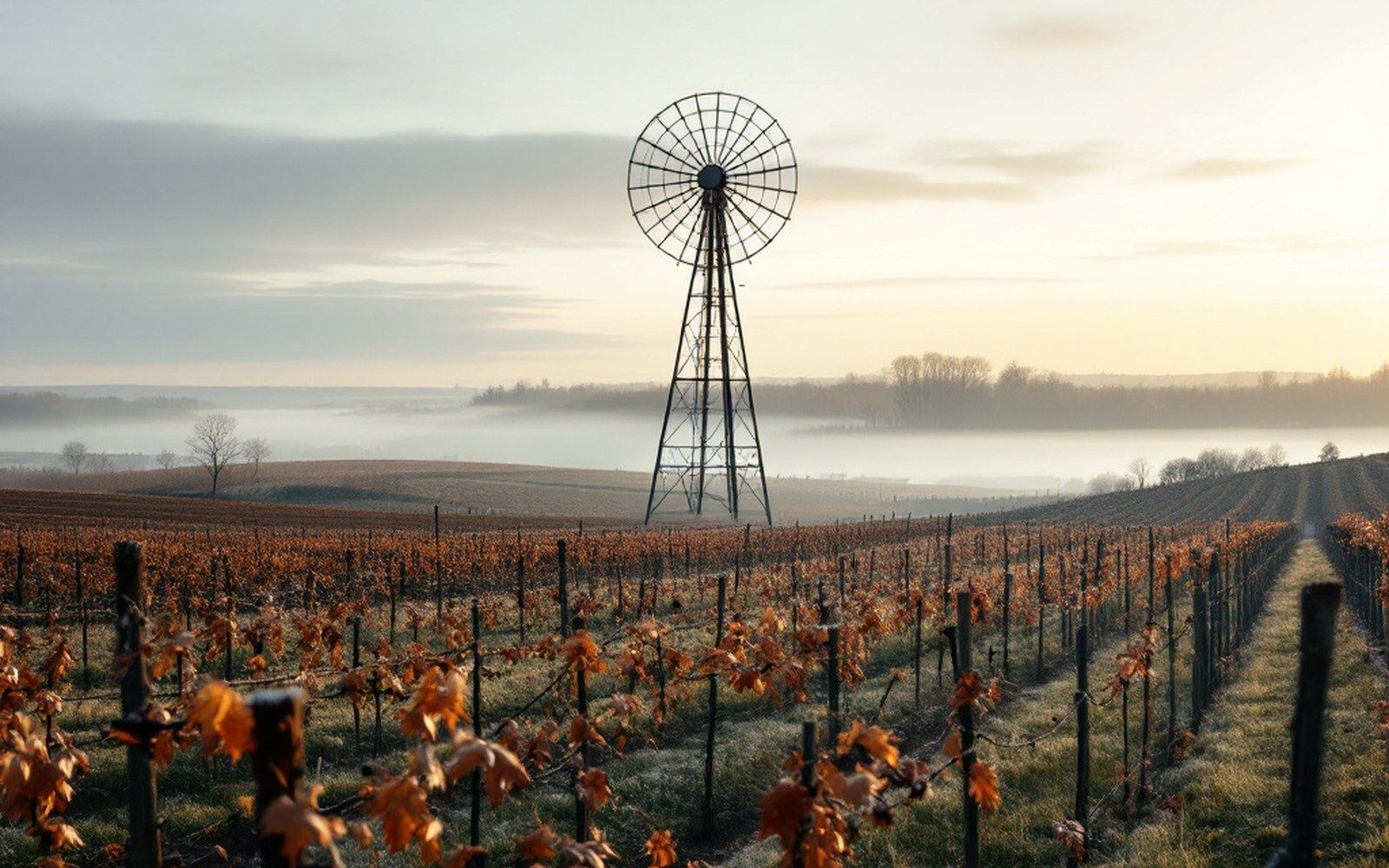
A fan tower over the fruit zone — bought once, for the nights that arrive every few winters.
How a radiation frost works
On a still, clear night the ground loses heat rapidly through radiation, and cold air — denser than warm — settles into every low pocket and hollow. The vine rows, sitting close to the soil, are exactly where that cold collects. The danger is not the regional temperature in any forecast but the local temperature at bud or berry level, which can sit several degrees below what a weather station records at shoulder height a kilometre away. That gap is what growers in the Niagara Peninsula manage against, and in the critical weeks around budburst and again in early winter, a few degrees are the difference between a crop and a loss.
The physical fact behind the problem is temperature inversion ↗: the air layer immediately above the frost-prone zone is actually warmer. On a clear, calm night that warmer layer can sit only five to fifteen metres up, and if you could stir it downward you would raise the temperature at vine level enough to prevent ice from forming on the tissue.
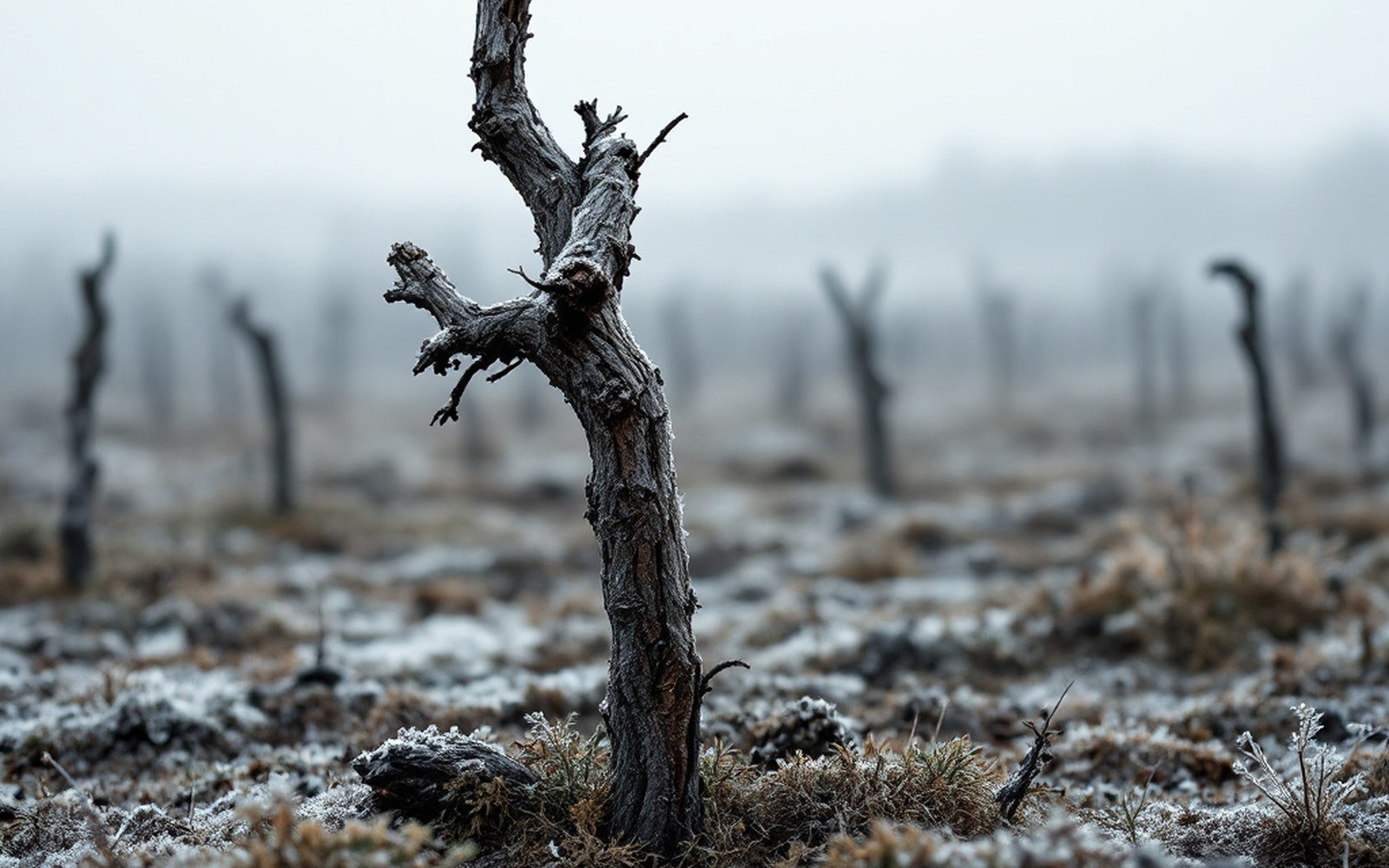
Split bark on a dead trunk. One night decided this, and the block around it lost years of wood.
What the machine does
A wind machine is a tall steel mast — typically nine to eleven metres — with a large, engine-driven propeller mounted at the top. It pulls air from that warmer inversion layer and pushes it down and outward across the vineyard floor. Rotation lets a single machine cover a cone of protection that can extend to roughly four to six hectares, depending on terrain and the severity of the frost. Some installations use two counter-rotating blades on the same mast; others pair machines across a block to close gaps in coverage.
The engine is almost always diesel or propane, because electrical supply to a remote vineyard block may be unreliable exactly when conditions demand instant response. Many growers automate the trigger: a thermostat at vine level starts the machine when temperature at that height crosses a set threshold — often around two degrees Celsius — giving protection even without a person watching through the night.
On the Beamsville Bench and the Twenty Mile Bench, where the Niagara Escarpment provides some natural cold-air drainage, machines are positioned to assist that drainage rather than fight against it, directing pooled air back toward slopes where it will move away naturally. On flatter sites in Four Mile Creek, where there is less natural relief, a machine has to work harder and coverage assumptions shrink accordingly.
The capital decision
A wind machine is not a seasonal consumable. Purchase, installation and commissioning run into tens of thousands of dollars per unit, and a block large enough to require two or three machines represents a commitment made at planting time, built into the economics of the site before a single harvest. The decision is inseparable from variety: a grower planting Riesling or Cabernet Franc, both vinifera and both cold-sensitive at the graft union, carries a different risk profile than one growing a hybrid with greater cold hardiness, and the machine is part of how that risk is managed.
The physical fact behind the problem is temperature inversion: the air layer immediately above the frost-prone zone is actually warmer.
Frost risk in the region is documented through long-run temperature records held by Environment and Climate Change Canada ↗, and responsible site assessment runs those records before a capital plan is drawn. What they show, across the Niagara Peninsula, is that the nights that threaten vinifera buds are not freak events — they occur with enough regularity that a machine is not insurance against a rare disaster but standard infrastructure against a recurring one.
The tower is, in that sense, as much a part of the vineyard as a trellis. You see it before you see the vines.